
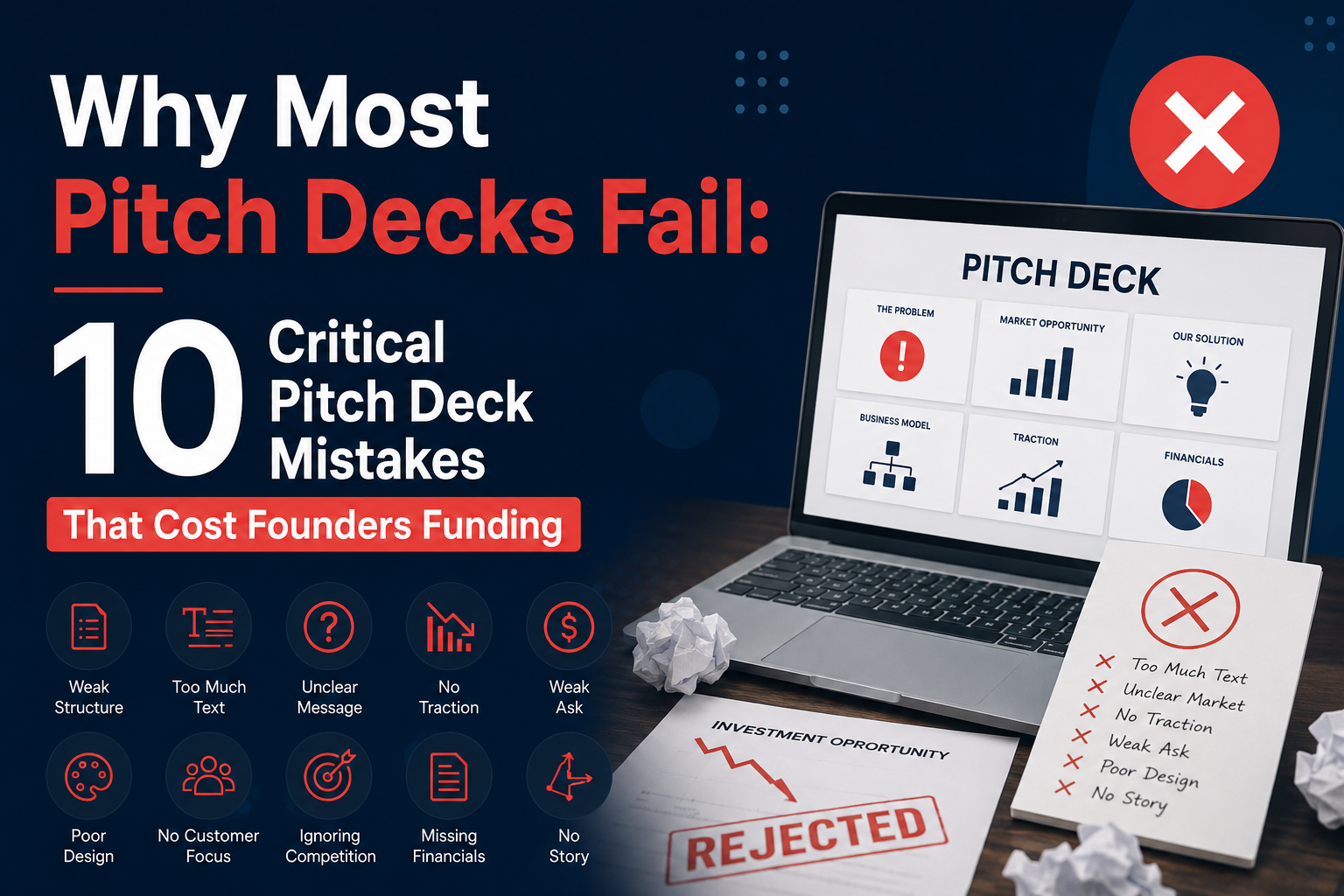
Why do most pitch decks fail?
Every year, investors review thousands of startup pitch decks. Only a small percentage lead to meaningful conversations, and even fewer result in funding. Surprisingly, most pitch decks do not fail because of bad business ideas. They fail because they do not communicate the opportunity effectively. Founders who misunderstand the pitch deck presentation format or presentation deck meaning often lose attention before investors reach traction or financials.
A pitch deck has one job: convince investors that your startup is worth a deeper conversation. When it fails to do that, even strong businesses can struggle to raise capital. Many of these failures overlap with the pitch deck mistakes founders make and the patterns explained in why most pitch decks fail.
Most pitch decks fail because founders focus on what they want to say rather than what investors need to understand. If the deck is confusing, cluttered, or lacks a compelling story, it can be rejected before the business receives a fair evaluation.
Key Takeaways
Every year, thousands of startups approach investors with innovative ideas, yet only a small percentage secure meetings or funding. Surprisingly, most pitch decks don't fail because the business idea is weak—they fail because the opportunity isn't communicated clearly.
A successful pitch deck isn't designed to answer every possible question. Instead, it should create enough confidence for investors to schedule the next conversation.
Before reviewing the common mistakes, remember these key principles:
- Investors evaluate opportunities, not just products.
- A clear business story is more persuasive than a visually impressive presentation.
- Every slide should reduce uncertainty and answer an important investor question.
- Customer validation and traction matter more than assumptions.
- The goal of a pitch deck is to earn another meeting, not close the investment.
How Investors Actually Review a Pitch Deck
Many founders imagine investors carefully reading every slide, but the reality is very different. Most investors spend only a few minutes reviewing a pitch deck before deciding whether they want to continue the conversation. During this initial review, they quickly scan for evidence that the business solves a meaningful problem, operates in a large market, has early signs of traction, and is led by a capable team.
If these elements are difficult to identify, investors rarely spend additional time searching for answers. Instead, they move on to the next opportunity.
This is why clarity matters more than complexity. A concise, well-structured presentation allows investors to understand the opportunity quickly while building confidence in the business.
10 Critical Pitch Deck Mistakes That Cost Founders Funding
Many startups fail to secure investor meetings not because of a bad business idea, but because their pitch deck fails to communicate the opportunity effectively. Investors review hundreds of decks every year and often decide within minutes whether a company deserves further consideration.
Below are some of the most common pitch deck mistakes founders make.
1. Focusing on Features Instead of Problems
Investors want to understand the problem first. If your pitch deck jumps directly into product features without explaining the customer pain point, it becomes difficult to understand why the solution matters.
2. Lack of Market Validation
Many founders make bold claims about market demand without supporting them with evidence. Investors look for customer feedback, user growth, revenue, partnerships, or other forms of validation.
3. Weak Value Proposition
A successful pitch deck clearly explains why customers should choose your solution over existing alternatives. If the value proposition is unclear, investors may struggle to see the business opportunity.
4. Unrealistic Financial Projections
Projecting millions in revenue without supporting assumptions can reduce investor confidence. Financial forecasts should be ambitious but grounded in realistic business assumptions.
5. Ignoring Competition
One of the biggest investor pitch deck mistakes is claiming there are no competitors. Every business competes for customer attention, budget, or alternative solutions.
6. Too Much Text
Crowded slides force investors to read instead of listening. Great pitch decks use concise messaging supported by visuals and data.
7. Poor Storytelling
A pitch deck should follow a logical narrative from problem to solution, market opportunity, traction, and growth strategy. Disconnected slides make it difficult for investors to follow the story.
8. No Clear Business Model
Investors need to understand how the company generates revenue. A pitch deck that lacks a clear business model often raises concerns about scalability.
9. Weak Traction Metrics
Investors want evidence that customers are interested in the product. Revenue growth, active users, retention rates, and partnerships help demonstrate traction.
10. Unclear Funding Requirements
Many founders forget to explain how much capital they are raising and how the funds will be used. Investors want clarity on funding needs and expected milestones.
How Investors Evaluate a Pitch Deck
When reviewing a pitch deck, investors typically focus on five core areas:
Market Opportunity
Is the market large enough to support significant growth?
Problem and Solution Fit
Does the company solve a meaningful problem in a unique way?
Business Model
Can the company generate sustainable revenue and scale efficiently?
Traction
Has the business demonstrated customer demand or market validation?
Team
Does the founding team have the experience and capability to execute the vision?
In summary
A pitch deck that addresses these areas clearly has a much higher chance of securing investor interest and follow-up meetings. Use pitch deck design services to refine each section of your investor pitch deck. Start with the pitch deck presentation format, then follow a clear pitch deck structure before you share the deck.
How to Make Sure Your Pitch Deck Doesn't Fail
The easiest way to avoid common pitch deck mistakes is to review your presentation from an investor's perspective rather than your own. Ask yourself whether someone unfamiliar with your business could understand your company within a few minutes.
Before sending your presentation, make sure you can clearly answer the following questions:
- What problem does the business solve?
- Why is this problem important?
- How is your solution different from existing alternatives?
- Is the market large enough to support long-term growth?
- Have you demonstrated customer traction?
- Is your revenue model easy to understand?
- Are your financial projections realistic?
- Why is your team capable of executing the business?
- How much funding are you raising, and how will it be used?
If any of these questions remain unanswered, your presentation may need further refinement before approaching investors.
Signs Your Pitch Deck Is Investor-Ready
A successful investor presentation shares several common characteristics. Rather than trying to include every detail about the business, it focuses on clarity, evidence, and storytelling.
Your pitch deck is likely investor-ready if it:
- Clearly defines a real customer problem.
- Demonstrates a unique and valuable solution.
- Includes realistic market research.
- Shows measurable customer traction.
- Explains the business model simply.
- Presents achievable financial projections.
- Highlights an experienced and capable founding team.
- Includes a clear funding request and planned use of investment.
- Maintains consistent branding and professional design.
- Can be understood without requiring additional explanation.
When these elements are present, investors can evaluate the opportunity more quickly and confidently.
Why Great Businesses Still Get Rejected
Many founders believe that having an excellent product guarantees investor interest. Unfortunately, this isn't always true. Investors make decisions based on the information presented to them, not on information that remains inside the founder's mind.
A startup may have innovative technology, strong customer demand, and significant growth potential, but if those strengths are not communicated effectively, investors may never recognise the opportunity.
This is why successful fundraising depends on both the quality of the business and the quality of its presentation. A strong pitch deck transforms complex ideas into a clear investment opportunity, making it easier for investors to understand the vision, evaluate the risks, and recognise the potential for long-term growth.
Frequently Asked Questions
What are the most common pitch deck mistakes?
The most common pitch deck mistakes include too much text, weak market validation, unrealistic financial projections, poor storytelling, and unclear business models.
Why do investor pitch decks fail?
Investor pitch decks fail when they do not clearly communicate the problem, solution, market opportunity, traction, and growth potential.
How many slides should a pitch deck contain?
Most successful investor pitch decks contain between 10 and 20 slides.
What do investors look for in a pitch deck?
Investors typically evaluate market size, business model, traction, competitive advantage, team strength, and financial potential.
Can poor design affect investor decisions?
Yes. Poor design can make information difficult to understand and may reduce investor confidence in the business.
Final thoughts
Most pitch decks don't fail because founders lack passion or innovative ideas. They fail because investors cannot quickly understand why the business deserves investment. Every slide should work together to reduce uncertainty, demonstrate market potential, and build confidence in the founding team. By combining clear storytelling, credible market validation, measurable traction, and professional presentation, founders can significantly improve their chances of securing investor meetings. Before sending your next pitch deck, review it from the perspective of someone seeing your business for the first time. If the opportunity is easy to understand and supported by evidence, you will be far more likely to move from an initial presentation to meaningful fundraising conversations.