Choosing the right chatbot for your business
Businesses today are increasingly using chatbots to improve customer service, automate workflows, and engage customers across multiple channels. However, not all chatbots are built the same.
Many organizations still use traditional rule-based chatbots, while others are investing in advanced AI-powered conversational solutions. Understanding the differences between these technologies is essential when deciding which solution is best for your business. For support-specific workflows, see how AI chatbots improve customer support, and for foundational context, start with AI chatbot development.
As customer expectations continue to evolve, companies are turning to AI chatbot development services to create more intelligent, scalable, and personalized customer experiences. In this article, we'll compare AI chatbots and traditional chatbots, explore their strengths and limitations, and help you determine which option aligns with your business goals.
What is a traditional chatbot?
A traditional chatbot is a rule-based system that follows predefined workflows and decision trees. These chatbots operate based on programmed rules and can only respond to questions that have been anticipated by developers.
For example, when a customer asks "What are your business hours?" the chatbot responds with "Our business hours are Monday to Friday from 9 AM to 6 PM." While traditional chatbots can handle simple interactions effectively, they struggle when users ask questions outside predefined scenarios.
How traditional chatbots work
Traditional chatbots typically rely on:
- Keyword matching
- Predefined scripts
- Decision trees
- Fixed conversational flows
If a user's query doesn't match a programmed response, the chatbot often fails to provide meaningful assistance.
What is an AI chatbot?
An AI chatbot is an intelligent conversational system that uses technologies such as:
- Artificial Intelligence
- Natural Language Processing (NLP)
- Machine Learning
- Generative AI
- Large Language Models (LLMs)
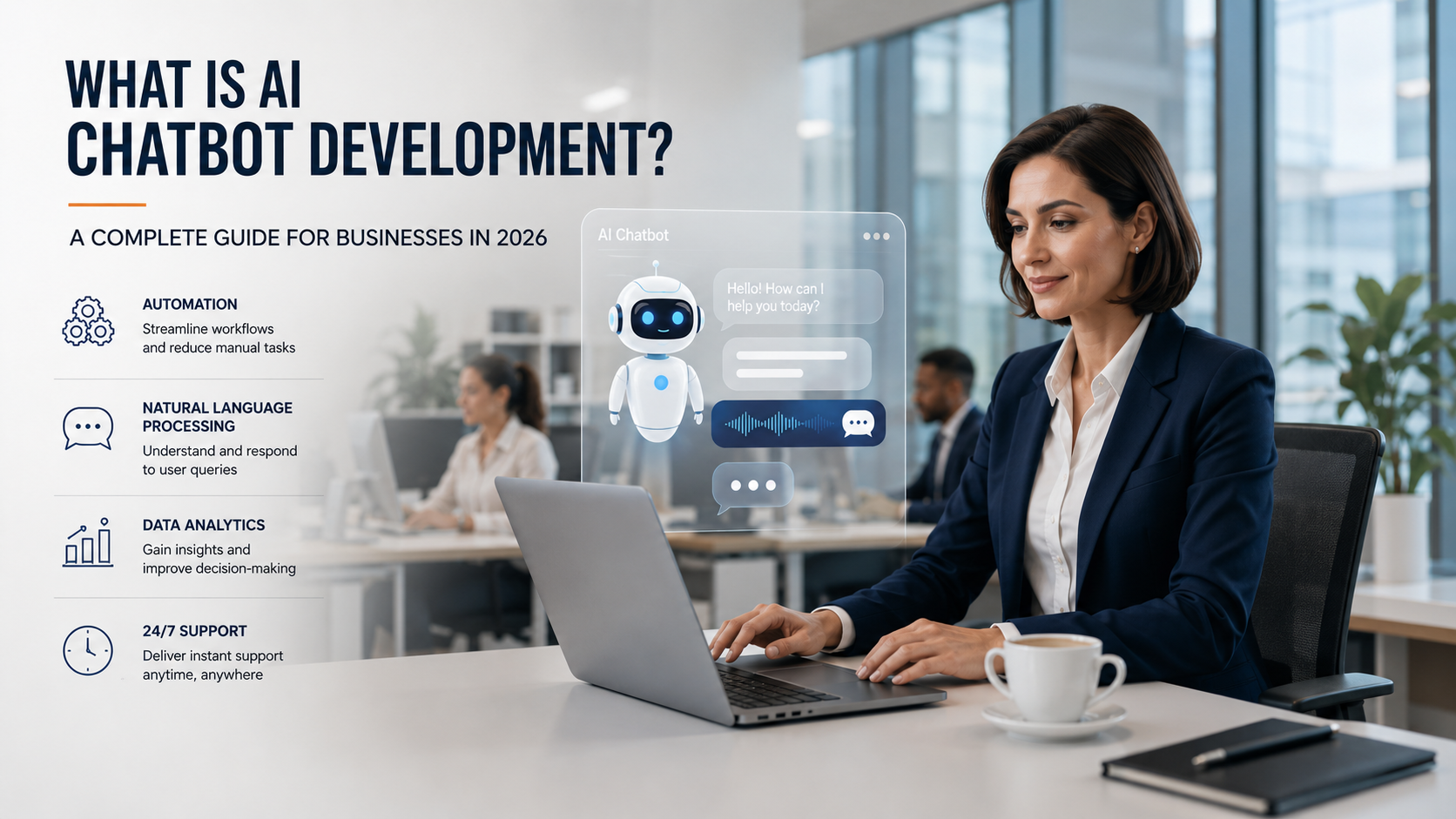
Unlike traditional chatbots, AI chatbots can understand context, interpret user intent, and generate dynamic responses. Instead of following rigid scripts, AI chatbots can engage in more natural and human-like conversations.
This is why businesses increasingly invest in professional AI chatbot development services to build smarter customer interaction systems.
Key differences between AI chatbots and traditional chatbots
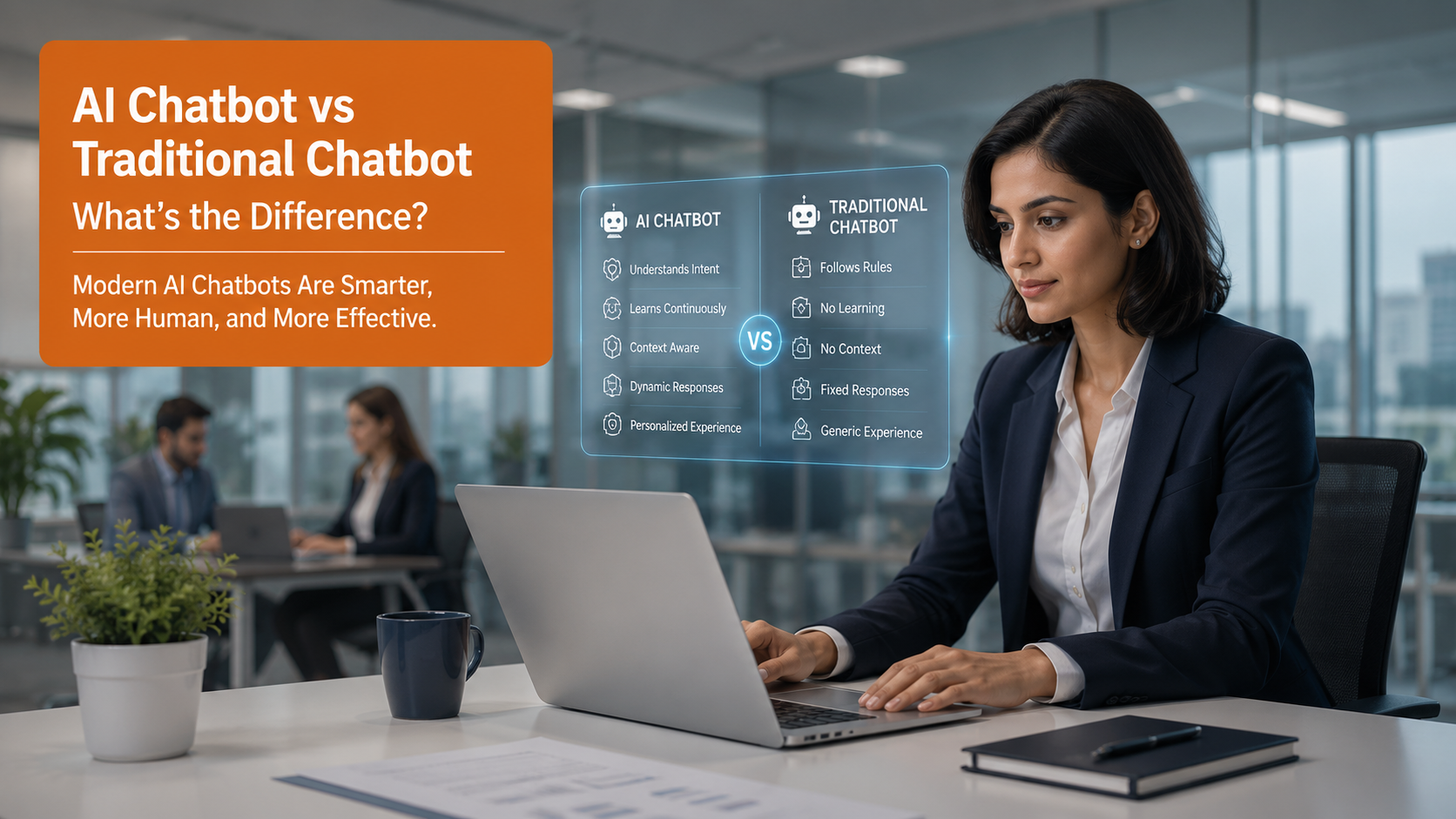
1. Understanding User Intent
Traditional chatbots rely on exact keywords or predefined phrases. If users phrase questions differently, the chatbot may not understand the request.
AI chatbots analyze the meaning behind customer messages and understand intent even when questions are phrased differently. This leads to more accurate and effective conversations.
2. Learning Capability
Traditional chatbots do not learn from previous interactions. Any improvements require manual updates from developers.
AI chatbots can learn from conversations, improve performance, and adapt to changing customer behavior. This allows businesses to continuously improve customer experiences.
3. Conversation Quality
Traditional chatbot conversations often feel robotic and limited. Users must follow specific conversation paths.
AI-powered conversations feel more natural and human-like. Customers can communicate more freely without following strict formats.
4. Personalization
Traditional chatbot personalization capabilities are limited. Most responses are generic and based on predefined workflows.
AI chatbots can personalize responses using customer history, preferences, previous interactions, and purchase behavior. This creates a more engaging customer experience.
5. Scalability
As business requirements grow, maintaining complex rule-based systems becomes difficult.
AI chatbots can handle large-scale interactions across multiple channels with minimal manual effort. This makes them ideal for growing businesses.
Advantages of traditional chatbots
Traditional chatbots still offer value in certain situations.
- Lower Initial Cost — simple rule-based chatbots are generally less expensive to build.
- Easy Implementation — businesses with straightforward support requirements can deploy traditional chatbots quickly.
- Suitable for Simple Tasks — traditional chatbots work well for FAQs, basic information requests, appointment confirmations, and simple workflows.
However, their limitations become apparent as customer expectations increase.
Advantages of AI chatbots
Organizations seeking long-term growth often choose AI chatbot development services because of the significant advantages AI offers.
- Better Customer Experience — AI chatbots provide faster, more relevant, and personalized responses.
- 24/7 Support — customers receive assistance at any time without requiring human intervention.
- Increased Efficiency — AI chatbots automate repetitive tasks and reduce support workloads.
- Improved Lead Generation — AI-powered bots can qualify prospects and route high-value leads to sales teams.
- Enhanced Decision-Making — businesses gain valuable insights from customer conversations and behavioral data.
Which chatbot is best for your business?
The right choice depends on your business requirements.
For most modern businesses, AI chatbots provide greater long-term value and flexibility.
Why businesses are choosing AI chatbot development services
The demand for AI chatbot development services has increased significantly as businesses seek ways to improve efficiency and customer engagement. Professional AI chatbot development services help organizations:
- Automate customer support
- Improve response times
- Reduce operational costs
- Increase lead conversions
- Enhance customer satisfaction
- Scale support operations
A customized AI chatbot can integrate with CRM systems, booking platforms, knowledge bases, and business applications to deliver seamless experiences.
Industries benefiting from AI chatbots
E-commerce
- Product recommendations
- Order tracking
- Customer support
Healthcare
- Appointment scheduling
- Patient assistance
- Information management
Travel
- Booking assistance
- Itinerary management
- Customer inquiries
Finance
- Account support
- Customer onboarding
- Service automation
SaaS and Technology
- User onboarding
- Technical support
- Knowledge management
The future of conversational AI
AI chatbot technology continues to evolve rapidly. Future advancements will include:
- More human-like conversations
- Voice-enabled assistants
- Autonomous AI agents
- Predictive customer support
- Advanced personalization
- Deeper business integrations
Organizations investing in AI chatbot development services today will be better positioned to meet future customer expectations.
Conclusion
While traditional chatbots can still serve simple automation needs, they lack the flexibility, intelligence, and scalability required by modern businesses.
AI chatbots provide a significantly better customer experience through natural conversations, personalization, and advanced automation capabilities. As businesses continue to focus on efficiency, customer satisfaction, and growth, investing in a professional AI chatbot development service has become a strategic decision rather than just a technology upgrade.
Companies that embrace AI-powered conversational solutions today will gain a competitive advantage by delivering faster, smarter, and more engaging customer experiences. For a side-by-side evaluation, read AI chatbot vs traditional chatbot, then explore how AI chatbots improve customer support in real workflows.