How AI Automation Is Transforming Modern Businesses
Businesses today operate in an environment where speed, efficiency, and customer experience determine success. Companies are under constant pressure to reduce costs, improve productivity, and deliver better services while managing increasing workloads. To meet these challenges, organizations are turning to AI automation.
Artificial Intelligence (AI) automation is no longer limited to large enterprises with extensive technology budgets. Businesses of all sizes are adopting AI-powered solutions to streamline operations, automate repetitive tasks, improve decision-making, and create better customer experiences.
From customer support and sales to marketing, finance, and human resources, AI automation is transforming how modern businesses operate. Organizations that embrace this technology are gaining a competitive advantage, while those that delay adoption risk falling behind.
What Is AI Automation?
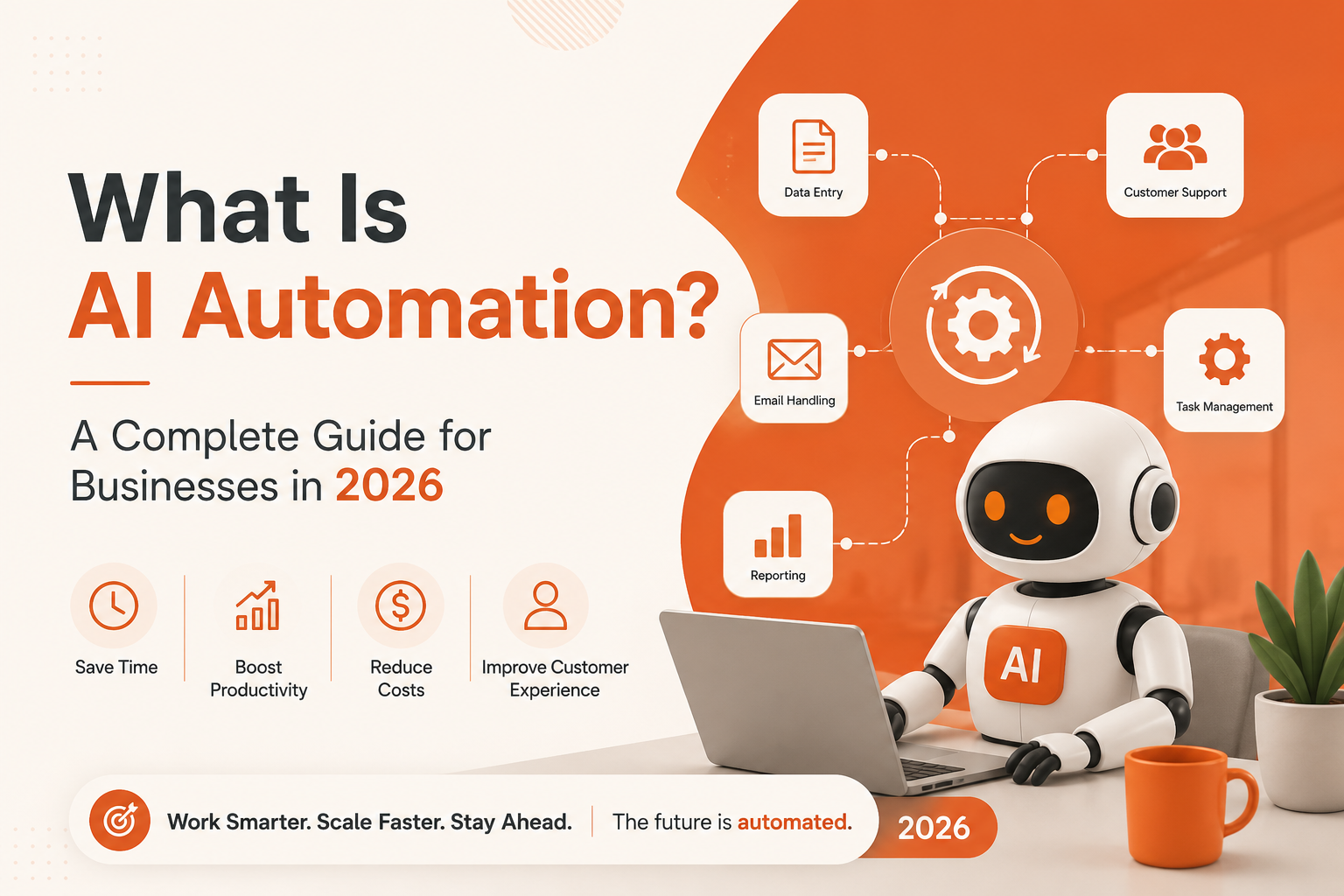
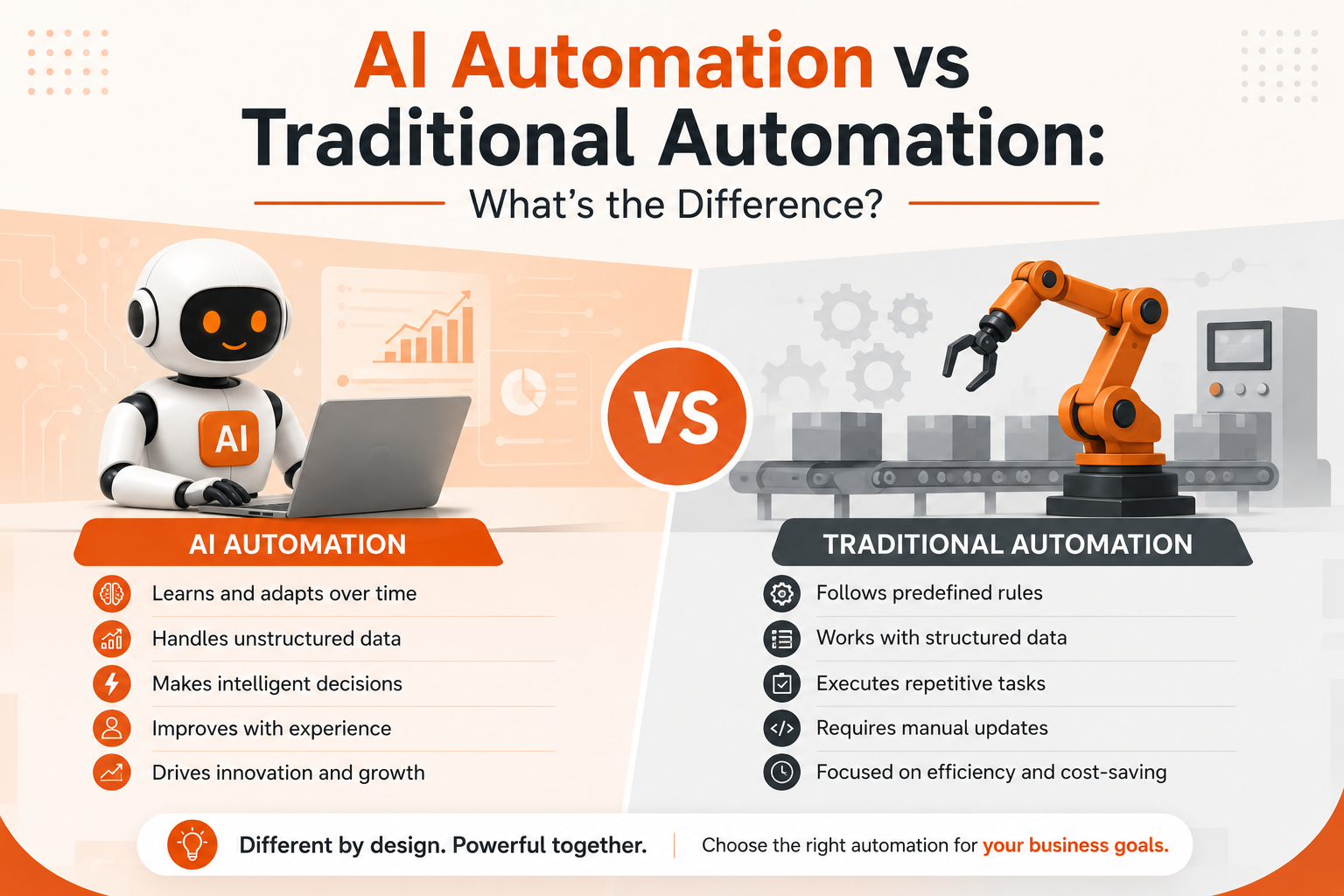
AI automation combines artificial intelligence technologies with automated workflows to perform tasks that traditionally require human involvement. Unlike traditional automation, which follows predefined rules, AI-powered systems can analyze data, recognize patterns, learn from interactions, and make intelligent decisions.
For example, a traditional workflow may automatically send an email when a customer submits a form. An AI-powered workflow can analyze customer intent, qualify the lead, personalize the response, schedule a meeting, and update the CRM without human intervention.
This ability to automate complex processes is what makes AI automation a transformative technology for modern businesses. For fundamentals, start with what is AI automation.
Why Businesses Are Investing in AI Automation
Organizations are increasingly investing in AI automation because manual processes often create inefficiencies, delays, and unnecessary operational costs.
Many businesses struggle with:
- Repetitive administrative tasks
- Slow customer response times
- High operational expenses
- Human errors in data processing
- Inefficient workflows
- Limited scalability
AI automation addresses these challenges by enabling businesses to work faster, smarter, and more efficiently. As AI technology continues to mature, businesses are discovering new opportunities to automate entire workflows rather than individual tasks.
Improving Operational Efficiency
One of the biggest impacts of AI automation is improved operational efficiency.
Employees often spend significant time on repetitive activities such as:
- Data entry
- Report generation
- Invoice processing
- Appointment scheduling
- Email management
- Document handling
AI-powered systems can perform these tasks automatically, allowing employees to focus on strategic initiatives that require creativity, critical thinking, and human expertise. This shift not only increases productivity but also improves employee satisfaction by reducing routine work.
Revolutionizing Customer Service
Customer expectations have changed dramatically in recent years. Customers expect instant responses, personalized interactions, and round-the-clock support.
AI automation is helping businesses meet these expectations through:
AI Chatbots
Modern AI chatbots can understand customer questions, provide accurate responses, resolve common issues, and guide users through processes without requiring human assistance.
Virtual Assistants
AI-powered virtual assistants can manage appointments, answer inquiries, provide product recommendations, and assist customers across multiple communication channels.
Automated Ticket Routing
AI systems can analyze support requests and automatically assign tickets to the appropriate departments, reducing response times and improving customer satisfaction. See how AI chatbots improve customer support for practical examples.
Enhancing Sales Performance
Sales teams often spend a significant amount of time on administrative work rather than building relationships and closing deals.
AI automation helps sales teams by:
- Capturing leads automatically
- Scoring and qualifying prospects
- Scheduling meetings
- Sending follow-up emails
- Updating CRM systems
- Generating sales reports
AI can analyze customer behavior and identify high-intent prospects, allowing sales representatives to focus their efforts where they are most likely to achieve results. This leads to higher conversion rates and increased revenue opportunities.
Transforming Marketing Operations
Personalize Customer Experiences
AI analyzes customer behavior and preferences to deliver highly personalized content, recommendations, and offers.
Automate Campaign Management
Businesses can automate email campaigns, social media scheduling, lead nurturing, and audience segmentation.
Optimize Advertising
AI tools continuously analyze campaign performance and adjust targeting strategies to maximize return on investment.
Streamlining Financial Processes
Finance departments are also benefiting from AI automation. Tasks such as invoice processing, expense management, reconciliation, and financial reporting often require significant manual effort.
AI can automate these processes by:
- Extracting data from invoices
- Detecting anomalies and fraud
- Processing payments
- Generating financial reports
- Monitoring compliance requirements
This reduces errors, improves accuracy, and allows finance teams to focus on strategic financial planning.
Improving Human Resources Management
HR departments manage numerous administrative processes that can be automated using AI.
Common HR automation applications include:
- Resume screening
- Candidate matching
- Interview scheduling
- Employee onboarding
- Performance tracking
- Workforce analytics
AI helps HR teams make faster and more informed hiring decisions while improving the employee experience throughout the recruitment process.
AI Agents: The Future of Business Automation
One of the most significant developments in AI automation is the emergence of AI agents. Unlike traditional automation tools that perform specific tasks, AI agents can manage entire workflows autonomously.
For example, an AI sales agent can:
- Engage website visitors
- Qualify leads
- Schedule meetings
- Send follow-up communications
- Update CRM records
- Generate performance reports
Similarly, AI support agents can handle customer interactions, resolve issues, escalate complex cases, and continuously improve through learning. AI agents represent the next phase of business automation and are expected to become increasingly common across industries.
Benefits of AI Automation
Businesses implementing AI automation often experience several key benefits:
- Increased Productivity: automating repetitive tasks allows employees to focus on higher-value activities.
- Reduced Costs: organizations can lower operational expenses by reducing manual effort and improving efficiency.
- Improved Accuracy: AI systems minimize human errors and maintain consistent performance.
- Faster Decision-Making: AI analyzes large datasets quickly, providing actionable insights in real time.
- Better Customer Experiences: automated support and personalized interactions improve customer satisfaction.
- Greater Scalability: businesses can handle increased workloads without proportionally increasing staffing requirements.
Challenges and Considerations
While AI automation offers significant advantages, successful implementation requires careful planning.
Businesses should consider:
- Data quality and availability
- Integration with existing systems
- Security and compliance requirements
- Employee training and adoption
- Long-term maintenance and optimization
Partnering with experienced AI automation service providers can help organizations overcome these challenges and maximize their return on investment.
The Future of AI Automation
The future of AI automation extends far beyond automating repetitive tasks. Businesses are moving toward intelligent systems capable of making decisions, managing workflows, and optimizing operations autonomously.
Advancements in generative AI, machine learning, voice AI, predictive analytics, and AI agents will continue to transform how businesses operate.
Organizations that adopt AI automation today will be better positioned to innovate, scale efficiently, and remain competitive in an increasingly digital economy.
Conclusion
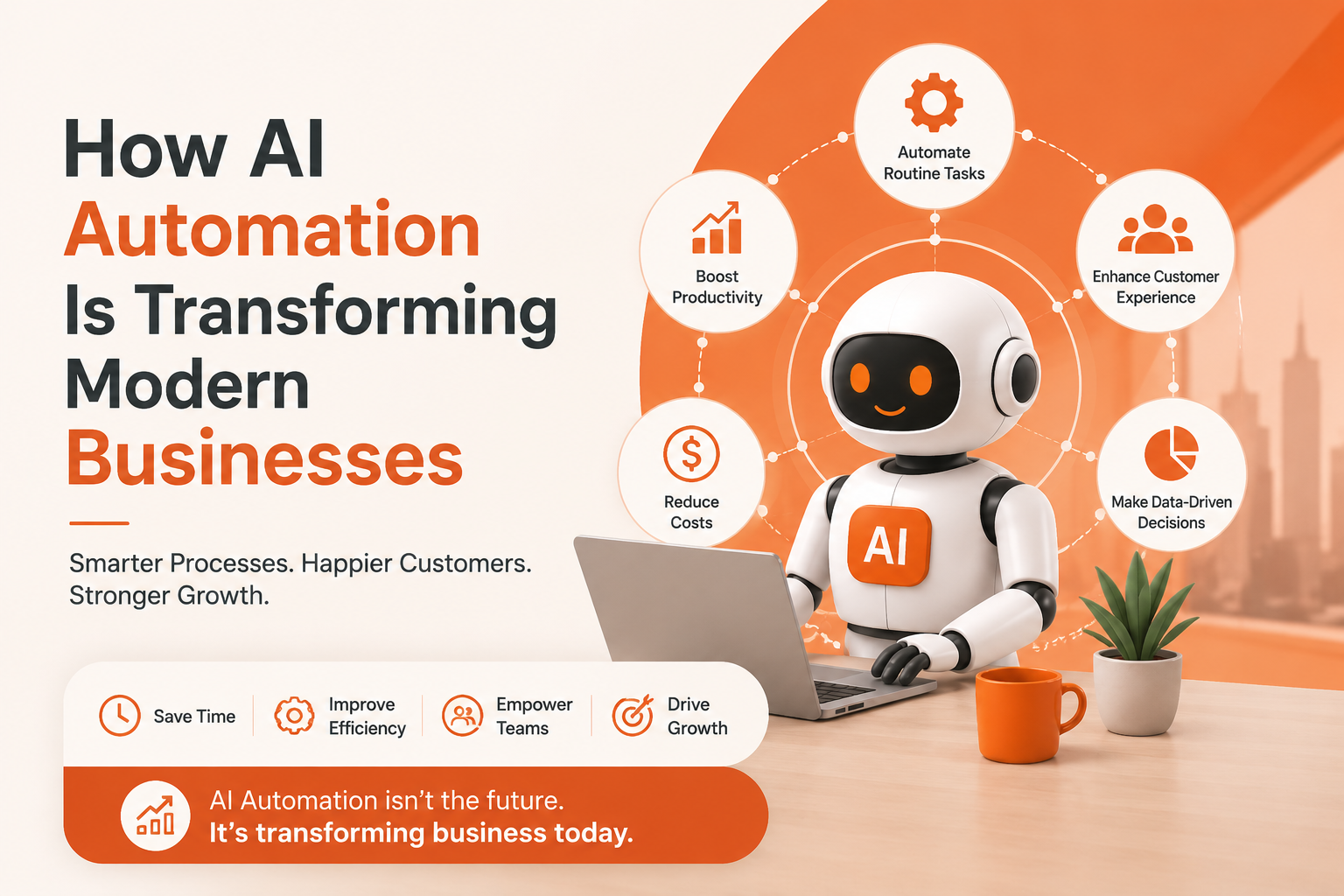
AI automation is fundamentally transforming modern businesses by improving efficiency, reducing costs, enhancing customer experiences, and enabling smarter decision-making. From customer support and sales to marketing, finance, and HR, AI-powered solutions are helping organizations automate complex processes and unlock new growth opportunities.
As AI technology continues to evolve, businesses that invest in AI automation will gain a significant competitive advantage. The question is no longer whether businesses should adopt AI automation—but how quickly they can implement it to stay ahead in the modern marketplace. Compare approaches in AI automation vs traditional automation and explore AI automation services to plan your next step.