AI Automation vs Traditional Automation: What's the Difference?
Automation has become a critical component of modern business operations. Organizations across industries use automation to improve efficiency, reduce costs, and streamline repetitive tasks. However, as artificial intelligence continues to evolve, many businesses are now evaluating whether traditional automation is enough or if they should invest in AI automation.
Although both approaches aim to improve productivity and reduce manual work, they function in very different ways. Understanding the differences between AI automation and traditional automation can help businesses choose the right solution for their needs.
In this guide, we'll explore how each type of automation works, their advantages, limitations, use cases, and why AI automation is becoming the preferred choice for many organizations in 2026.
What Is Traditional Automation?
Traditional automation refers to systems that execute predefined tasks based on fixed rules and workflows. These systems are programmed to follow specific instructions and perform actions when certain conditions are met.
For example:
- Sending an email when a customer submits a form
- Automatically generating invoices at the end of each month
- Moving data between software applications
- Triggering notifications when a process is completed
Traditional automation works exceptionally well when processes are predictable and follow consistent patterns. Businesses have used traditional automation for decades to improve operational efficiency and reduce repetitive manual work.
How Traditional Automation Works
Traditional automation relies on:
- Rule-based workflows
- Predefined logic
- Fixed conditions and triggers
- Structured data inputs
The system performs exactly what it has been programmed to do. If conditions change or unexpected scenarios arise, human intervention is often required.
For example, if a workflow is programmed to process invoices in a specific format, it may fail when presented with a different document structure.
What Is AI Automation?
AI automation combines automation with artificial intelligence technologies such as machine learning, natural language processing (NLP), computer vision, and generative AI.
Unlike traditional automation, AI-powered systems can:
- Learn from data
- Recognize patterns
- Understand language
- Adapt to changing situations
- Make intelligent decisions
Instead of simply following predefined rules, AI automation analyzes information and determines the most appropriate action based on context.
For example, an AI customer support system can understand customer intent, analyze previous interactions, generate personalized responses, and continuously improve its performance over time. This ability to learn and adapt makes AI automation significantly more powerful than traditional automation.
Key Differences Between AI Automation and Traditional Automation
1. Decision-Making Capability
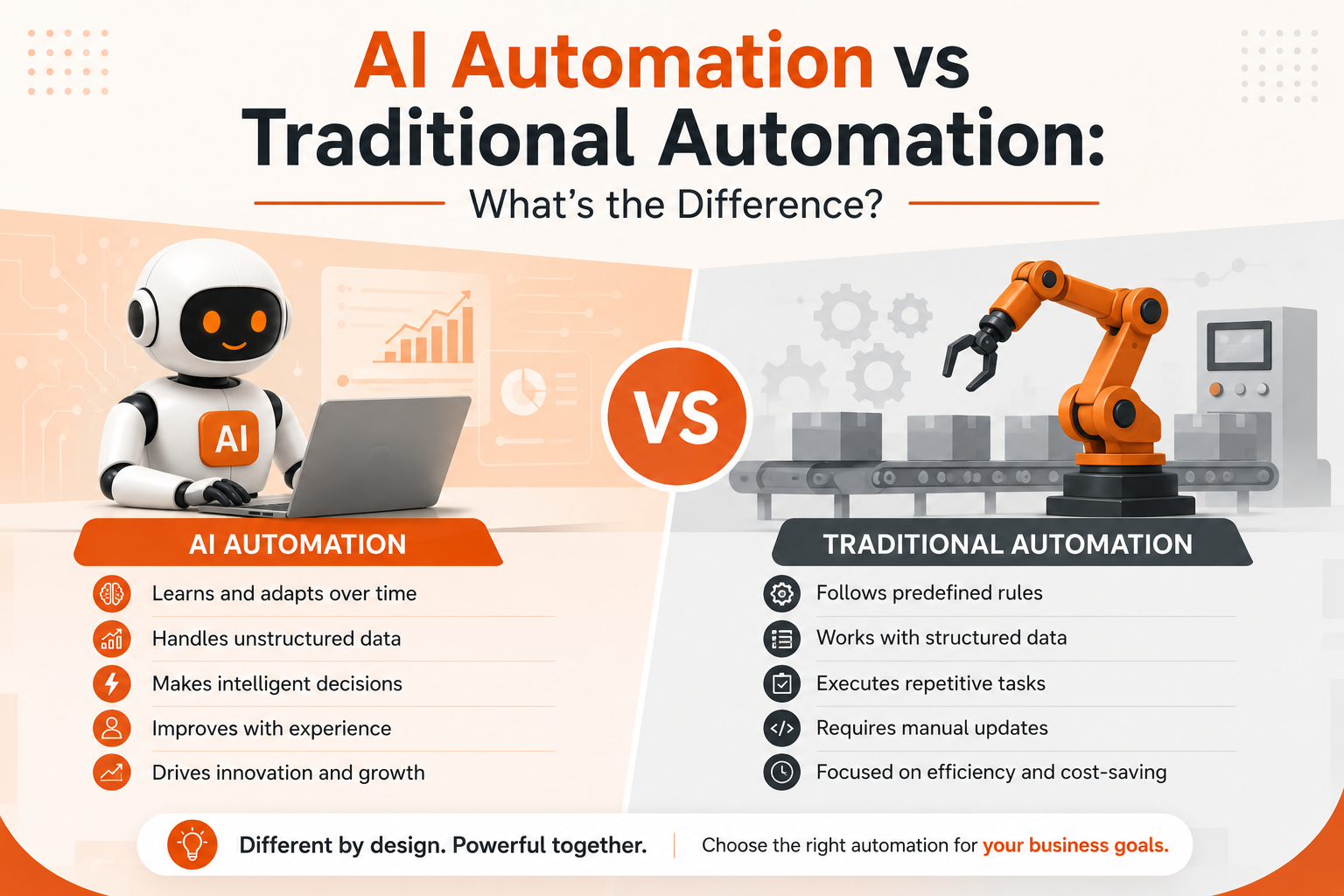
Traditional automation follows predefined instructions. It cannot make decisions beyond the rules programmed into the system. AI automation can evaluate information, identify patterns, and make decisions based on context and data analysis.
2. Learning Ability
Traditional systems do not learn from experience. Any improvement requires manual updates from developers. AI systems continuously learn from data and interactions, improving accuracy and performance over time.
3. Handling Unstructured Data
Traditional automation works best with structured data such as spreadsheets, forms, and databases. AI automation can process both structured and unstructured data, including emails, images, documents, audio recordings, customer conversations, and social media content.
4. Flexibility
Traditional automation has limited flexibility because workflows depend on predefined rules. Any process changes typically require workflow redesign. AI automation is highly adaptable and capable of handling exceptions, variations, and evolving business requirements.
5. Complexity of Tasks
Traditional automation is best suited for simple, repetitive tasks such as data transfers, notifications, form processing, and report generation. AI automation can automate complex workflows involving analysis, interpretation, prediction, and decision-making such as lead qualification, customer support, fraud detection, demand forecasting, and predictive maintenance.
Traditional Automation Use Cases
Traditional automation remains highly valuable for many business processes.
Workflow Automation
Automatically routing documents, approvals, and requests between departments.
Data Synchronization
Moving information between software systems such as CRM, ERP, and accounting platforms.
Scheduled Tasks
Generating reports, sending reminders, and updating databases on predefined schedules.
Invoice Processing
Automating routine billing and payment workflows using fixed rules. For predictable processes, traditional automation can deliver excellent results with relatively low implementation costs.
AI Automation Use Cases
AI automation expands the possibilities of what businesses can automate.
AI Customer Support
AI chatbots and virtual assistants can handle customer inquiries, resolve issues, and provide personalized support.
Sales Automation
AI analyzes customer behavior, scores leads, and identifies high-value opportunities.
Marketing Automation
AI personalizes campaigns, segments audiences, predicts customer behavior, and optimizes advertising performance.
Document Intelligence
AI extracts information from invoices, contracts, PDFs, and forms regardless of formatting differences.
Financial Analysis
AI detects fraud, identifies anomalies, and provides predictive insights.
AI Agents
AI agents can autonomously manage complete workflows such as lead generation, customer service, and operational processes.
Advantages of Traditional Automation
- Lower Initial Costs: implementation is generally simpler and less expensive.
- Easy to Understand: rule-based workflows are straightforward and predictable.
- Reliable for Repetitive Tasks: works exceptionally well for structured, repetitive processes.
- Faster Deployment: organizations can often deploy traditional automation quickly without extensive data requirements.
Advantages of AI Automation
- Greater Efficiency: AI automates both repetitive tasks and complex decision-making processes.
- Continuous Improvement: machine learning allows systems to become more accurate over time.
- Better Customer Experiences: AI enables personalized interactions and faster response times.
- Scalability: businesses can automate increasingly sophisticated workflows without proportional increases in staffing.
- Competitive Advantage: organizations gain valuable insights and operational efficiencies that are difficult to achieve manually.
Which Solution Is Right for Your Business?
The answer depends on your business requirements.
Traditional automation is often ideal when:
- Processes are highly predictable
- Data is structured
- Decision-making is minimal
- Budget constraints are significant
AI automation is often the better choice when:
- Processes involve decision-making
- Customer interactions are important
- Data is unstructured
- Personalization is required
- Scalability is a priority
Many organizations achieve the best results by combining both approaches. For example, a company might use traditional automation for workflow routing and AI automation for customer support and lead qualification.
The Future: Intelligent Automation
The future of business operations lies in intelligent automation—a combination of traditional automation and artificial intelligence.
Intelligent automation allows businesses to:
- Automate end-to-end workflows
- Improve decision-making
- Increase operational efficiency
- Enhance customer experiences
- Reduce costs at scale
As AI technologies become more accessible, organizations are increasingly shifting from simple rule-based workflows to intelligent systems capable of managing complex business processes.
Conclusion
Traditional automation and AI automation both play important roles in modern business operations. Traditional automation excels at handling repetitive, rule-based tasks, while AI automation enables organizations to automate more complex processes involving learning, analysis, and decision-making.
For businesses looking to improve efficiency, reduce costs, and create better customer experiences, AI automation offers significant advantages. However, the most effective strategy often involves combining traditional automation with AI-powered capabilities to create intelligent, scalable workflows.
As businesses continue their digital transformation journey, understanding the differences between these approaches will be essential for making informed automation investments and staying competitive in 2026 and beyond. Start with what is AI automation, explore how AI automation is transforming modern businesses, and compare conversational automation in AI chatbot vs traditional chatbot.