What Is AI Automation? A Complete Guide for Businesses in 2026
Artificial Intelligence (AI) is no longer a futuristic concept. It has become a practical business tool that helps organizations automate repetitive tasks, improve decision-making, and increase operational efficiency. As businesses face growing competition and rising customer expectations, AI automation has emerged as one of the most valuable investments for organizations of all sizes.
In this guide, we'll explore what AI automation is, how it works, its benefits, common use cases, and why businesses are increasingly adopting AI automation services in 2026.
What Is AI Automation?
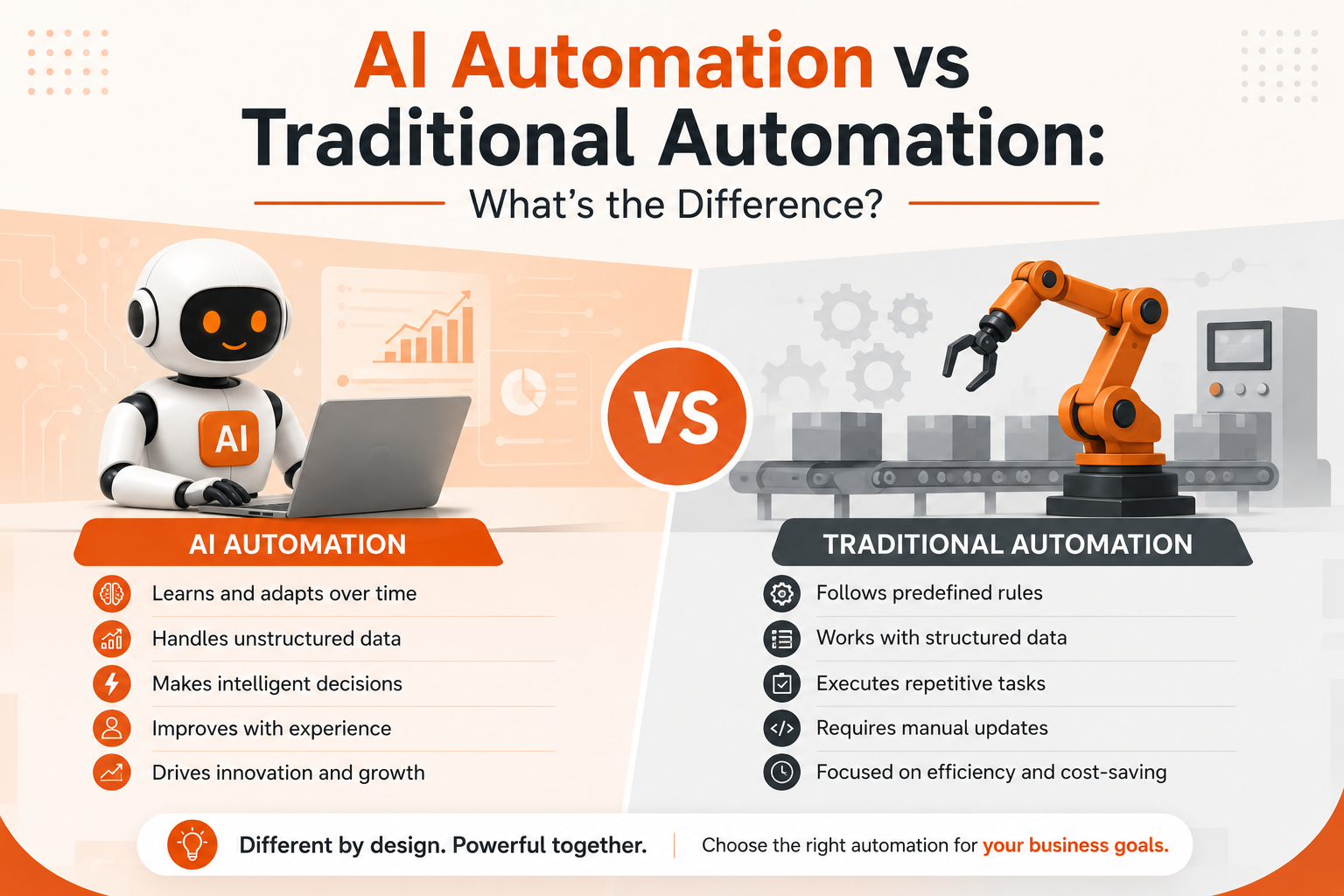
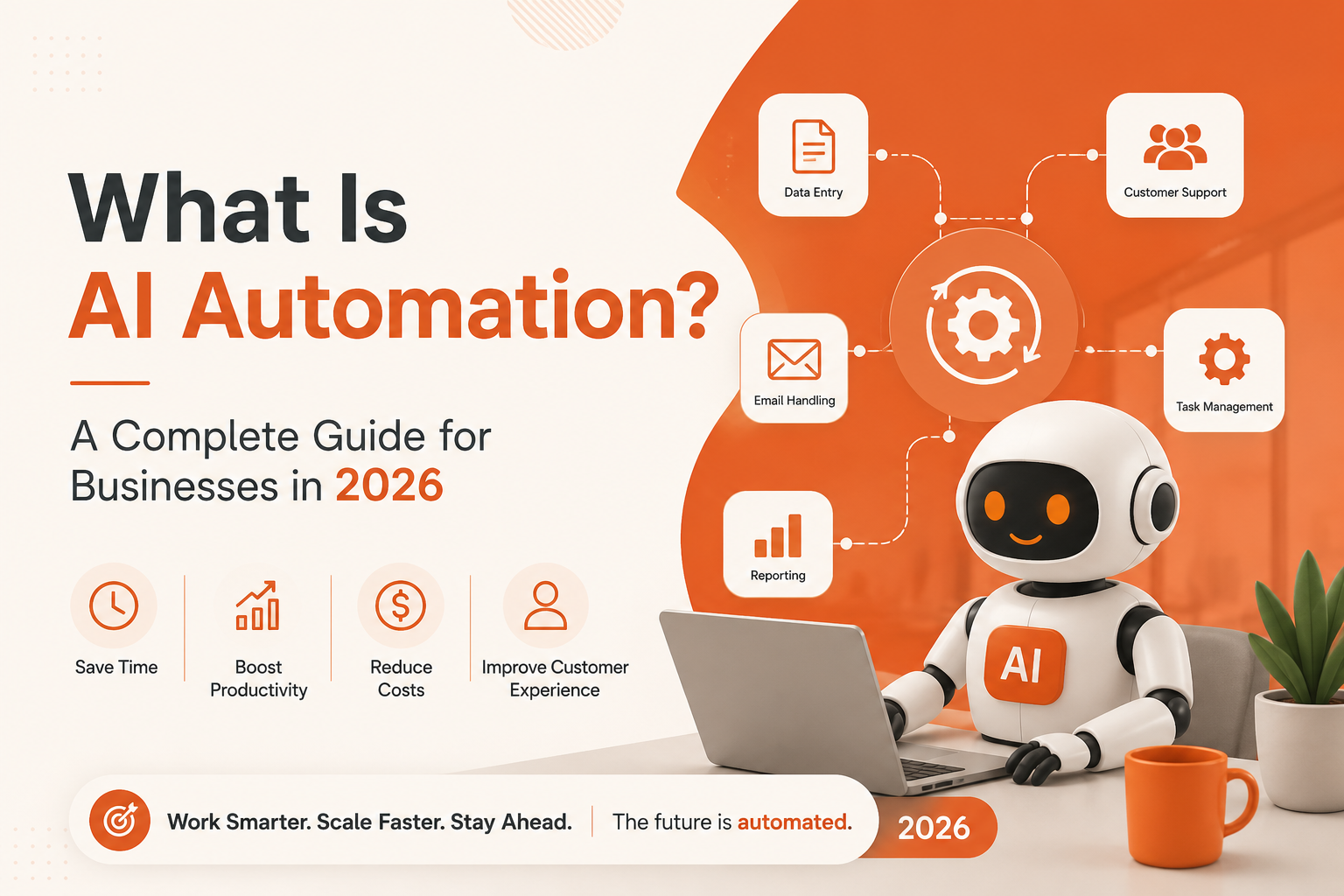
AI automation refers to the use of artificial intelligence technologies to automate tasks, processes, and workflows that traditionally require human intervention. Unlike traditional automation, which follows predefined rules, AI-powered automation can learn from data, adapt to changing conditions, and make intelligent decisions.
For example, traditional automation can automatically send an email when a form is submitted. AI automation goes a step further by analyzing the user's intent, qualifying the lead, generating a personalized response, and routing the inquiry to the appropriate department.
By combining machine learning, natural language processing (NLP), computer vision, and generative AI, businesses can automate complex processes while improving accuracy and efficiency.
How AI Automation Works
AI automation systems typically operate through four key stages:
1. Data Collection
The system gathers information from various sources such as websites, CRM platforms, customer interactions, emails, documents, and databases.
2. Analysis and Learning
AI algorithms analyze the collected data to identify patterns, trends, and behaviors. Machine learning models continuously improve their performance based on new data.
3. Decision Making
The AI system evaluates information and determines the most appropriate action based on predefined goals and learned insights.
4. Automated Execution
Once a decision is made, the system performs the required action automatically, such as sending notifications, updating records, generating reports, or responding to customers.
AI Automation vs Traditional Automation
Many businesses confuse AI automation with standard workflow automation. While traditional automation remains useful, AI automation offers greater flexibility and scalability for modern business operations.
Traditional Automation
- Rule-based
- Requires predefined instructions
- Limited flexibility
- Suitable for repetitive tasks
- Minimal intelligence
AI Automation
- Data-driven and adaptive
- Learns from patterns and data
- Handles dynamic situations
- Suitable for complex decision-making
- Advanced intelligence and prediction
For a deeper comparison, read AI automation vs traditional automation and see how each approach fits different business needs.
Benefits of AI Automation for Businesses
Increased Productivity
Employees often spend hours performing repetitive tasks such as data entry, document processing, scheduling, and customer support. AI automation eliminates these manual activities, allowing teams to focus on strategic work.
Cost Reduction
Businesses can significantly reduce operational expenses by automating routine tasks. AI systems work continuously without overtime costs, helping organizations achieve higher efficiency with fewer resources.
Improved Accuracy
Human errors can lead to costly mistakes. AI-powered systems consistently process information with high accuracy, reducing errors in workflows and decision-making.
Faster Customer Service
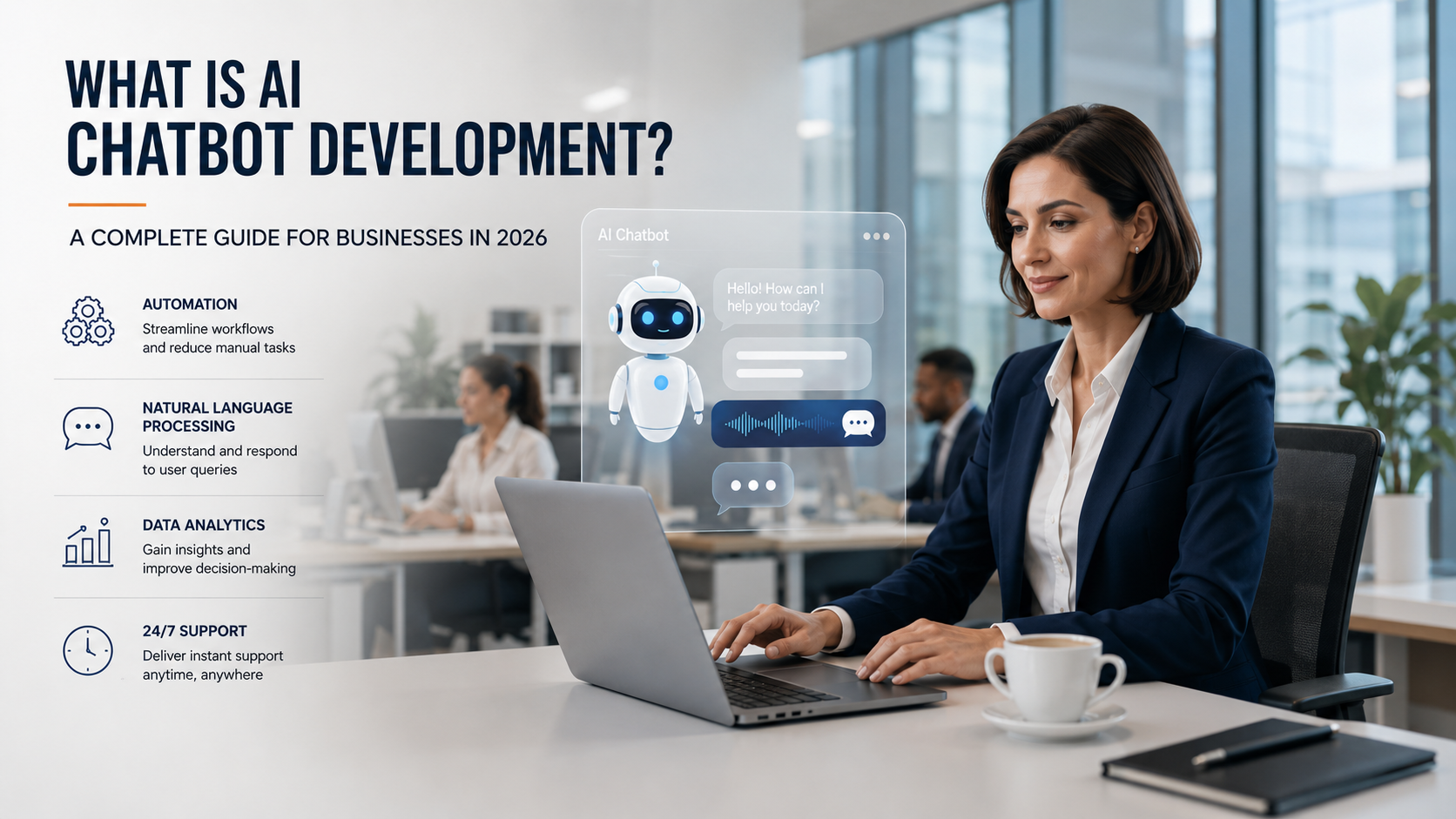
AI chatbots and virtual assistants can handle customer inquiries instantly, providing 24/7 support and improving customer satisfaction.
Better Decision-Making
AI analyzes large volumes of data in real time, helping businesses identify opportunities, predict trends, and make informed decisions.
Scalability
As businesses grow, AI automation solutions can easily handle increasing workloads without requiring proportional increases in staff.
Common AI Automation Use Cases
Customer Support Automation
AI chatbots and virtual assistants can answer frequently asked questions, resolve common issues, and route complex queries to human agents.
Sales and Lead Qualification
AI systems can analyze leads, score prospects, schedule meetings, and automate follow-ups, helping sales teams focus on high-value opportunities.
Marketing Automation
Businesses use AI to create personalized campaigns, segment audiences, generate content, and optimize advertising performance.
Document Processing
AI can automatically extract information from invoices, contracts, forms, and reports, reducing manual data entry and improving efficiency.
HR and Recruitment
Organizations use AI automation to screen resumes, schedule interviews, onboard employees, and manage workforce operations.
Finance and Accounting
AI helps automate invoice processing, expense management, fraud detection, financial reporting, and compliance monitoring.
AI Agents: The Next Evolution of Automation
One of the biggest trends in 2026 is the rise of AI agents. Unlike traditional chatbots, AI agents can perform complete workflows independently.
For example, an AI sales agent can:
- Capture leads from a website
- Qualify prospects
- Schedule meetings
- Send follow-up emails
- Update CRM records
- Generate sales reports
This level of autonomous operation is transforming how businesses manage daily operations.
Why Businesses Are Investing in AI Automation Services
Implementing AI successfully requires expertise in strategy, integration, development, and optimization. This is why many organizations partner with AI automation service providers.
Professional AI automation services help businesses:
- Identify automation opportunities
- Build custom AI solutions
- Integrate AI with existing systems
- Develop AI chatbots and virtual assistants
- Automate workflows and processes
- Monitor and optimize AI performance
Working with experienced AI specialists reduces implementation risks and accelerates return on investment.
Challenges to Consider
While AI automation offers significant benefits, businesses should also address potential challenges:
- Data quality issues
- Integration complexity
- Employee training requirements
- Security and compliance concerns
- Initial implementation costs
A well-planned AI strategy can help organizations overcome these challenges and maximize business value.
The Future of AI Automation
As AI technology continues to evolve, automation capabilities will become increasingly intelligent and autonomous. Businesses will move beyond automating simple tasks toward automating entire business processes.
AI agents, predictive analytics, intelligent workflow systems, and autonomous decision-making platforms are expected to play a major role in shaping the future workplace.
Organizations that adopt AI automation early will gain a competitive advantage through increased efficiency, better customer experiences, and faster innovation.
Conclusion
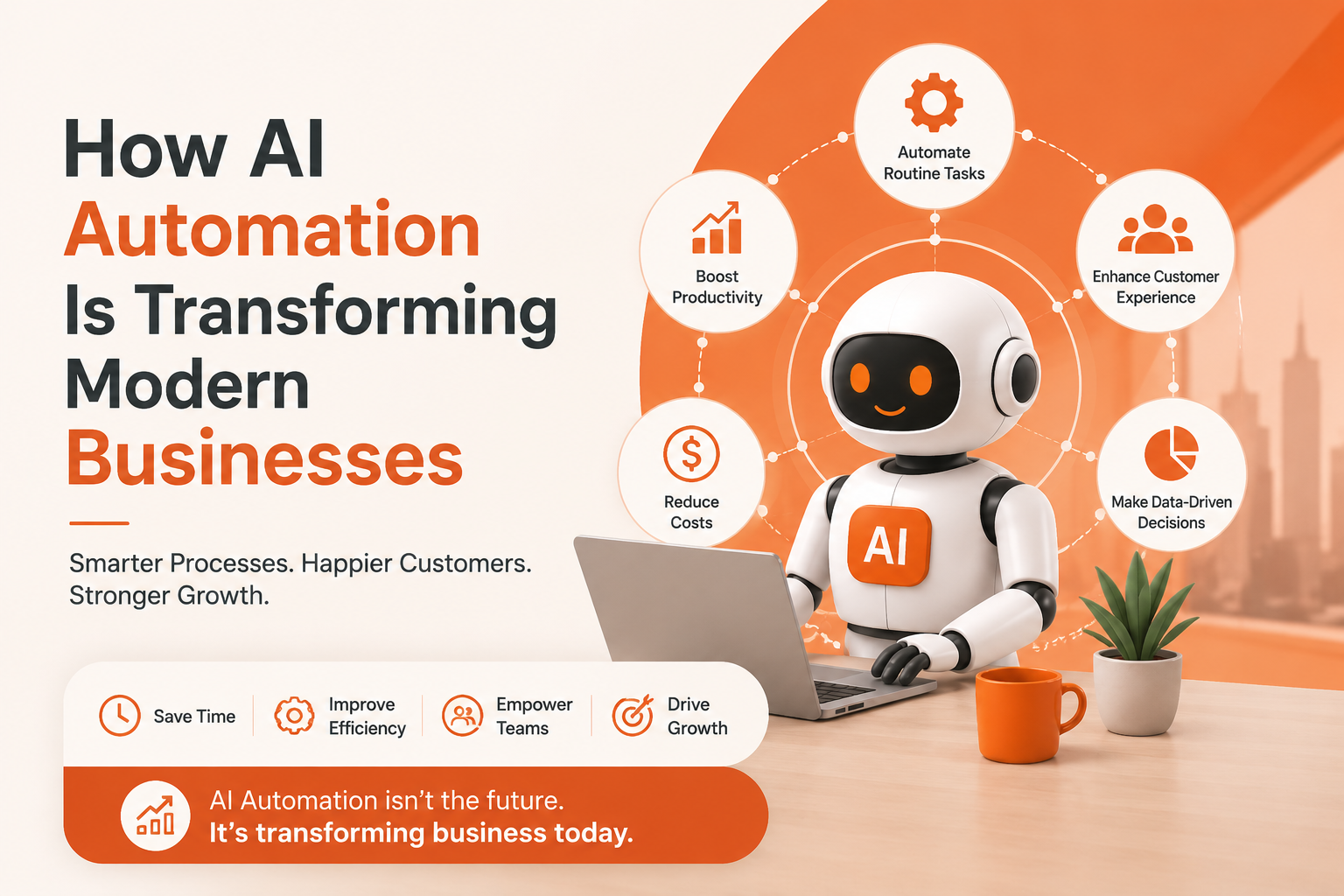
AI automation is transforming how businesses operate in 2026. By combining artificial intelligence with workflow automation, organizations can reduce costs, improve productivity, enhance customer experiences, and scale more effectively.
Whether you're looking to automate customer support, sales processes, marketing campaigns, or internal operations, AI automation offers significant opportunities for growth. Businesses that embrace AI automation today will be better positioned to compete and succeed in an increasingly digital world.
Investing in the right AI automation services can help organizations unlock the full potential of artificial intelligence and build smarter, more efficient business operations for the future. Continue with how AI automation is transforming modern businesses and AI chatbot development for related implementation paths.